Blight may still pose a threat even after low pressure year in 2025
There is no guarantee of a repeat of last year’s very low late blight pressure season in 2026 and vigilance is vital in controlling disease, the audience at a GB Potatoes seminar at the British Potato Industry Event heard.
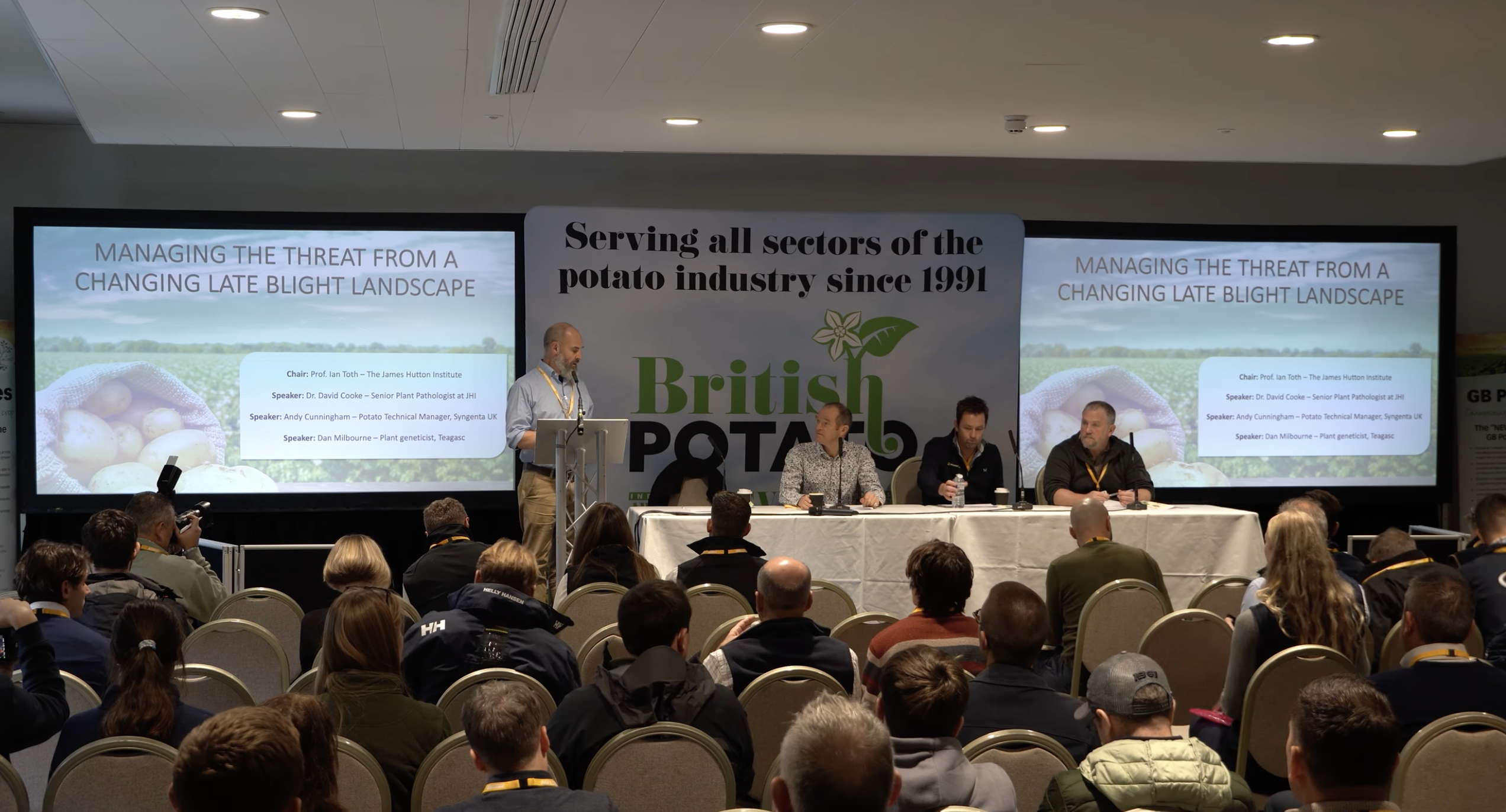
“2025 was very unusual; it was incredibly dry with very low blight pressure which led to very low levels of primary inoculum, especially in the east of the country,” said Dr David Cooke, senior plant pathologist at the James Hutton Institute (JHI).
“As a result, more than half of the confirmed outbreaks occurred after September.”
Forensic DNA genotyping of blight strains showed that the EU46 strain accounted for 23% of the outbreaks found, although that only amounted to seven sites and the type remains limited to the west of the country. Dr Cooke said that it was important that the EU43 strain, which is resistant to the fungicide Mandipropamid was not detected in Great Britain in 2025. However, the aggressive strain EU36 remains the dominant type, while EU37, EU13 and EU6 types remain at low frequencies.
Data from the EuroBlight monitoring programme mirrored the UK information, with EU36 remaining the dominant strain, while EU46 increased from 4% to 7% of the 1,200 positive samples. The EU43 strain stabilised, although frequency in France increased a little and it was found in Switzerland and Latvia for the first time.
JHI also tested the efficacy of fungicides in 2025. EU36 and EU41 remained sensitive to Oxathiapiprolin, but EU46 showed clear resistance. Meanwhile, all isolates remained sensitive to Propamocarb and Fluopicolide.
Dr Cooke thanked growers, agronomists and others who have helped with the Fight Against Blight campaign, including GB Potatoes which has accessed AHDB legacy funds to support the programme. He urged everyone to engage with the campaign again this year to help control the disease.
The over-reliance of single-site fungicides in certain parts of Europe led to the worst blight outbreak in 30 years in 2023 as the EU43 strain took hold and, Andy Cunningham, field technical manager at Syngenta told the seminar audience. He stressed three principles to a robust control programme:
- Avoid repeated solo applications of single‑site fungicides.
- Use mixtures and alternate modes of action.
- Follow robust spray programmes that limit any single active ingredient to a small proportion of total applications (e.g., no more than 21% in a 16‑spray programme).
Potato breeding is offering the prospect of much more genetic control of late blight, according to Dr Dan Milbourne, a Molecular Geneticist at Teagasc, the Irish Agriculture and Food Development Authority.
He said that dual-gene varieties are already entering the market, but they could be superseded by multi-gene stacked varieties that are in development which could have even stronger levels of resistance. Rapidly-developing marker-assisted technology is helping breeders investigate multiple resistance genes simultaneously and combine them more effectively.
Dr Milbourne shared results from the cross-Europe IPMorama project, which has trials in the UK, Poland and France.
“What we have found is that resistant varieties often require dramatically fewer sprays,” he said.
“In some low-pressure situations, resistant varieties required no fungicide applications at all. Meanwhile, in some high-pressure locations, fungicide use could be roughly halved without significant loss of control.”
The full seminar can be watched here
Stay Updated
Sign up to receive the latest news from the GB Potatoes executive team and from across the industry. Bringing you news and information on upcoming events fortnightly direct to your inbox.
Please contact us if you would like to include a news item.
Join our mailing list here: